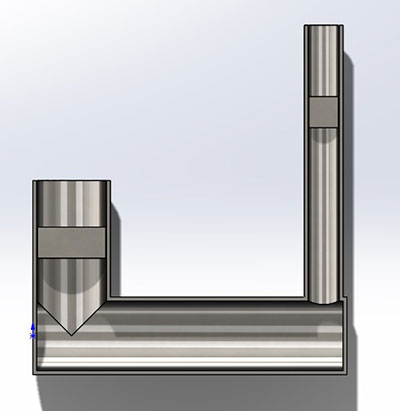
Hydraulics is the study of the transmission of forces through liquids. Hydraulic systems take advantage of a special property of liquids: fluids cannot be compressed. They transmit a built-up pressure evenly throughout the entire system.
But hydraulics can do more than just distribute and transmit force. The special thing about hydraulics is that it makes it particularly easy to generate large forces. This is made possible by the phenomenon of pressure intensification.
Pressure intensification in communicating cylinders
A simple hydraulic system consists of a closed container to which two hydraulic cylinders are connected. If one cylinder moves into the container, the hydraulic pressure pushes the other cylinder out of the container. However, the displaced volume always remains the same: the extending cylinder extends exactly as far as the retracting cylinder displaces volume in the container.
The trick in pressure intensification is to use two cylinders with different cross-sections. A small cylinder requires very little force to move deep into a hydraulic container. In doing so, it pushes out a working cylinder with great force – but with only a small stroke. However, when it comes to building up large forces, the stroke height per pump cycle is irrelevant. The only thing that matters is that the goal of the pumping capacity is achieved.
The pallet jack is a practical example of pressure intensification
A pallet jack is a classic hydraulic system in a practical application: the handle serves as a lever that acts on a small hydraulic pump. The cylinder on which the lever acts has a narrow cross-section. The working cylinder, on the other hand, has a much wider cross-section. If the narrow cylinder is pushed deep into the hydraulic tank, the working cylinder extends slightly. Through a system of check valves, the small cylinder can be pulled out again without losing the built-up pressure. In this way, a load weighing tons can be lifted with little force and repeated pumping.
To lower the load, simply pull a small lever. This opens the check valve. The hydraulic fluid flows back into the pump tank from the acting cylinder and the system is depressurized.
Exponential proportionality in pressure intensification
Cylinders basically have a circular base area. The formula for calculating the area of a circle is pi times the radius squared (A=π·r2). If you double the radius, you quadruple the circular area – and thus the increase in pressure in the hydraulic system. With a triple diameter, you already get nine times the pressure and so on. However, this does not change the work itself. The working cylinder extends, but the greater the difference in area between the acting and working cylinders, the slower the stroke becomes.
Stability and tightness as a prerequisite for pressure intensification
Hydraulic systems are particularly demanding when it comes to the stability of all pressure-carrying systems and the seals. Pressures of several hundred bar can arise within hydraulic lines. Safely containing these is always a particularly high design challenge in pressure intensification.