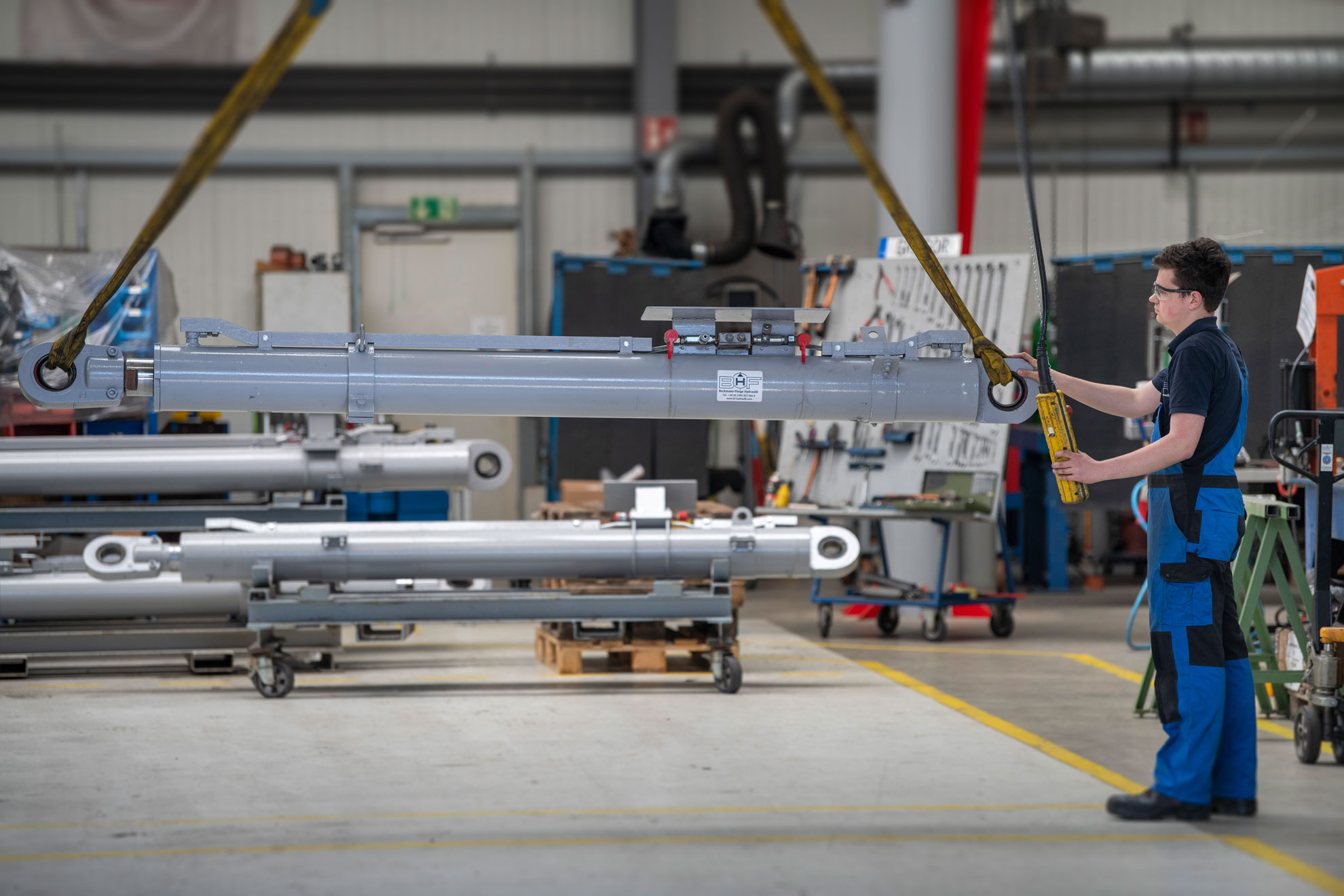
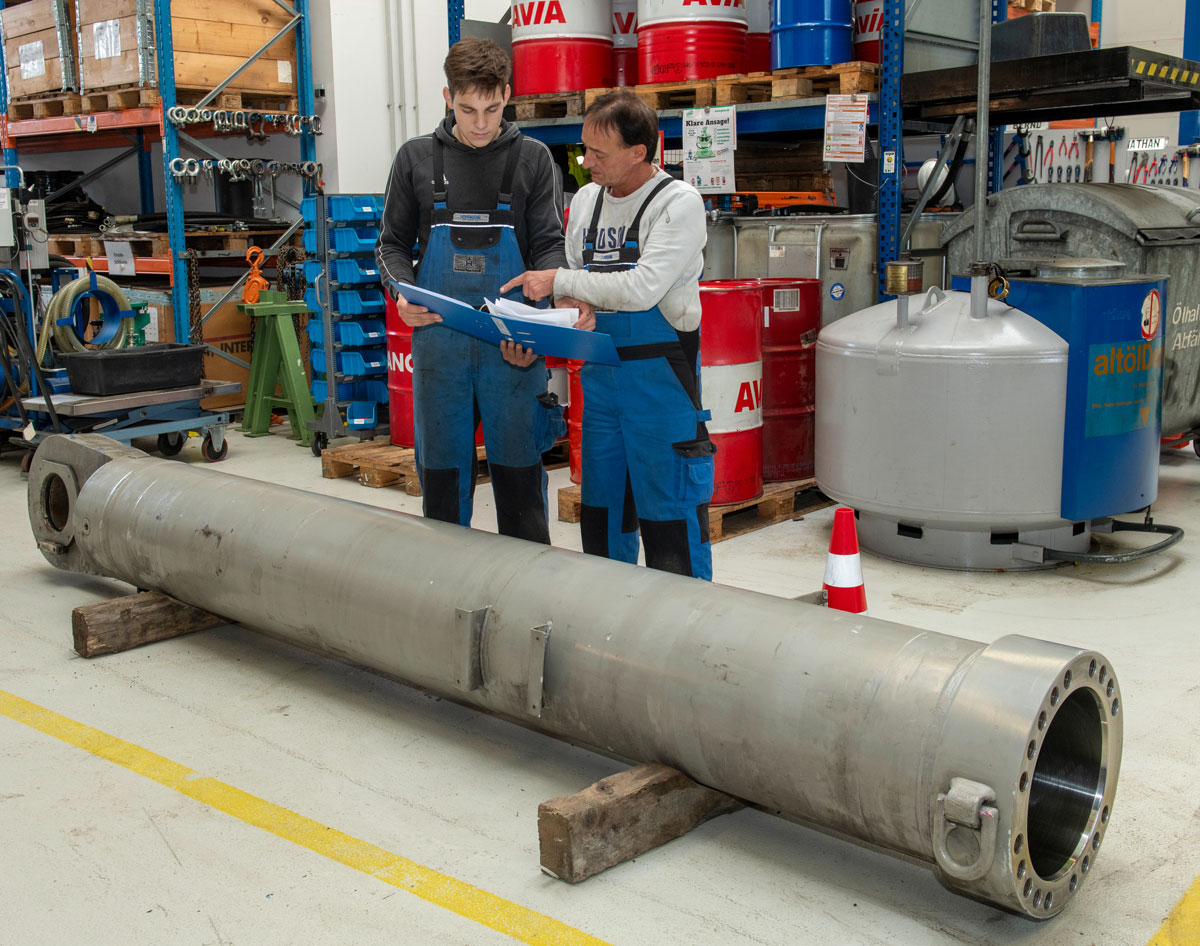
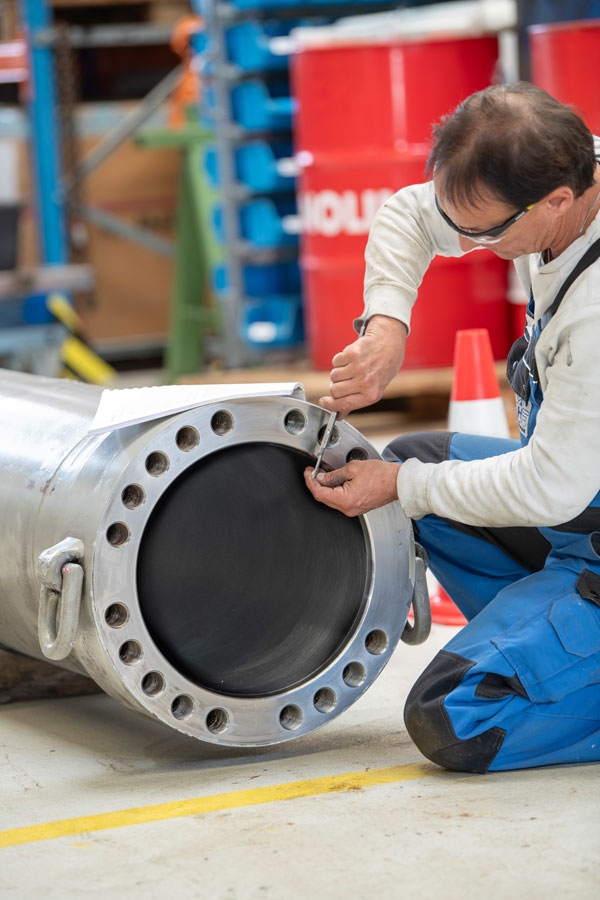
First, a distinction is made between two basic designs: single-acting and double-acting hydraulic cylinders. Within these two basic designs, there are various other configurations.
Single-Acting Cylinders
Single-acting cylinders have only one pressure port, meaning hydraulic fluid is applied to only one side of the piston for the forward stroke. The return stroke occurs passively via a spring, dead weight, or other external force. They are used, for example, in lifting platforms.
The following basic designs exist within single-acting cylinders:
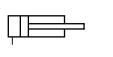
the return movement occurs, for example, through vertical gravity
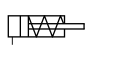
the return movement occurs via the spring
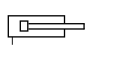
The piston rod serves directly as the piston
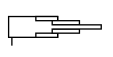
Double-Acting Cylinders
Double-acting cylinders have at least two pressure ports. Forward and return strokes are active directions of movement and can be precisely controlled.
The following basic designs exist within double-acting cylinders:
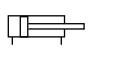
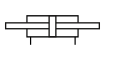
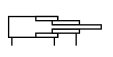
In hydraulic end-position cushioning, movements are cushioned by diverting the fluid through a throttled cross-section. The driven elements reach their endpoints gently, and the movement is smoothed and controlled. This prevents damage to machines and buildings and significantly extends the service life of the components.
- Immense power transmission despite small volumes.
- Movement sequences can occur from a standstill even under extremely high loads.
- Despite high power transmission, elegant safety and emergency systems can be implemented.
- Hydraulic systems are infinitely adjustable in terms of force and speed.
- They are extremely versatile in their applications.
- Special designs allow for extremely powerful cylinders that achieve enormous force conversion.
- Control can be achieved via mechanical or electronic remote controls.
- Modern control electronics allow hydraulic systems to be easily automated.
A key difference between pneumatics and hydraulics is that the gases or air used in pneumatics can be compressed, meaning they are compressible. In contrast, the fluid used in hydraulics is incompressible.
Every system has its strengths and weaknesses:
Hydraulics
Advantages:
- Extremely high forces.
- Precise control – force and speed are infinitely adjustable.
- High performance in a small space.
- Safe – low risk of explosion, as fluids do not store pressure energy.
- Durable – robust, long service life.
Disadvantages:
- Price – the system and fluid are relatively expensive.
- Complex systems
- Environmental factor – leaks, etc.
- Speed – very fast movements are not possible.
Pneumatics
Advantages:
- Price – air is a free medium.
- Speed – high flow velocities are possible.
- Installation – systems are less complex, easy to assemble.
- Clean – an advantage in the food industry, for example.
Disadvantages:
- Imprecise control – precise control / exact movements are not possible.
- Energy loss – a lot of compression heat is lost.
- Risk of explosion – heating and cooling can lead to sudden high pressure, which can cause explosions.
- Wear – pneumatic drives wear out quickly and must be replaced regularly.
- Performance – higher forces are only possible with very large cylinder surface areas.
To prevent wear of the hydraulic cylinder over long periods of use, there are strict requirements regarding permissible temperatures and internal pressures.
A maximum operating temperature of 80°C has been established for standard hydraulic cylinders, as otherwise the viscosity changes extremely and the system no longer operates according to specifications.
Seals
The seals of standard hydraulic cylinders typically consist of organic-synthetic polymers. Polytetrafluoroethylene (PTFE), butadiene rubber (NBR), and polyurethane (PU) are primarily used. Certain maximum temperatures also apply to these seals.
In particularly difficult environments, seals made of special rubber compounds such as fluorocarbon rubber (FKM) are used, which allow operating temperatures of up to 200°C.
The temperature of the hydraulic fluid must always be monitored, as the internal temperature can rise briefly, especially during frequent movement sequences.
Hydraulic Fluids
The fluid used is crucial for the operable temperature ranges of the hydraulic cylinders.
Mineral oil-based fluids according to ISO-DIN are most commonly used. these include hydraulic oils (HL), hydraulic oils with corrosion protection (HLP), and hydraulic oils with additives for temperature resistance and viscosity behavior.
Biodegradable pressure fluids are primarily used for environmental protection reasons and consist of a mixture of vegetable oils, esters, or olefins.
Flame-resistant pressure fluids are used in systems that must withstand a high temperature range during operation.
By mixing water, oil, and other additives, operating temperatures between single-digit positive degrees and up to 60–80°C are often achieved. However, it can be even more extreme. HFC pressure fluids have a tolerance of -20°C to +60°C. For high temperatures between +20°C and 150°C, HFD pressure fluids are primarily used.
Pressures
The requirements for permissible maximum pressures are equally strict. These must not be exceeded even briefly, as this can lead to system failure.
Pressure peaks must not be caused by the hydraulic pump or by external mechanical influences (kinking of the hoses). If the pressure requirements are not met, damage to seals, hoses, the pump, or the hydraulic cylinder itself will definitely occur.
Despite good maintenance and responsible control by a specialist, pressure peaks can occur. Therefore, most modern hydraulic systems today have internal safety mechanisms. These safeguards can be implemented through shock absorbers or end-position cushioning, among other things.
In hydraulic systems that inevitably exhibit pressure peaks, special block or punching block cylinders are used, which can withstand many times the usual system pressure within the system. An example is industrial punching machines, which tolerate regular pressure peaks through these special cylinders.